
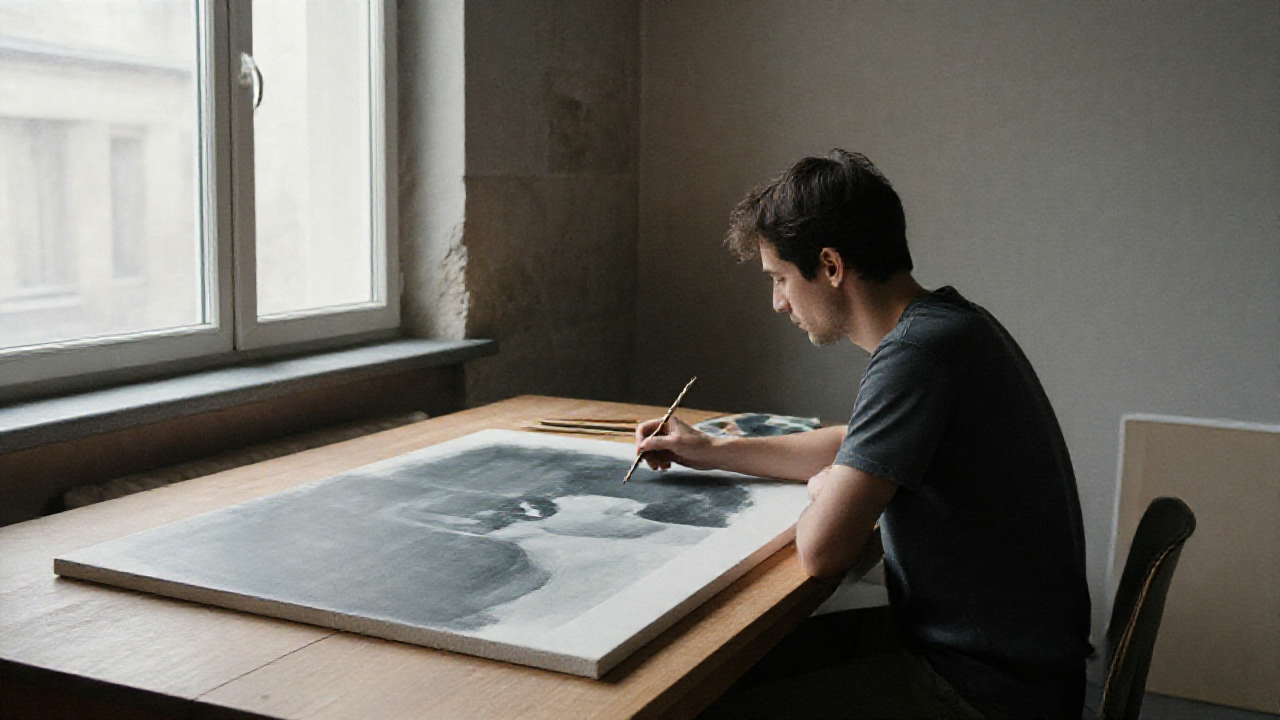
I sit at my desk most mornings, the canvas waiting patiently beside me. Today, I find myself pondering a question that has been niggling at the edges of my mind: what does minimalism mean for artists? It’s a concept increasingly being applied to creative processes, and as someone who has spent years exploring both art and business, I can’t help but wonder how it might enhance my practice.
What Does Minimalism Mean for Artists?
Minimalism in art and design emphasizes reducing elements to their essentials1. It’s a stark contrast to the cluttered and complex works that dominate many artistic movements. For artists like myself, this means stripping away unnecessary details to reveal the core of an idea. I’ve been experimenting with this approach lately, trying to simplify my compositions to their most basic forms. The challenge is not just in reducing elements but also in ensuring every element serves a purpose. It’s a humbling process that forces me to think deeply about what I’m trying to convey.
Minimalism isn’t merely about removing elements; it’s about adding intention and meaning. Each brushstroke, each line, must have a reason for being there. This practice has forced me to be more deliberate in my choices. For instance, when working on a recent piece, I found myself using just three colors: black, white, and grey. The simplicity of this palette allowed me to focus entirely on the interplay between light and shadow, creating a sense of depth that would have been lost with a broader spectrum.
How Can Minimalism Enhance Creativity?
Minimalist designs focus on functionality and the user experience1. In painting, this means creating works where every brushstroke has a reason. It’s about finding the balance between simplicity and depth. I’ve noticed that when I limit my palette to just a few colors or shapes, my creativity is actually sparked rather than stifled. The lack of distraction allows me to focus more intently on the essence of what I’m trying to express.
Moreover, minimalism can evoke a sense of calm and tranquility, offering a visual respite from the chaos of the world2. This peace is something that I value deeply in my work. It’s not just about creating aesthetically pleasing pieces; it’s about tapping into a state of mind where the distractions are minimal, and the focus is on the core idea.
One example of this can be seen in the works of Sol LeWitt, who is known for his grid based installations and drawings. His pieces often use simple geometric shapes and a limited color palette to create complex yet serene visual experiences. This approach resonates with me as an artist because it demonstrates how minimalism can lead to profound and meaningful work.
Examples of Minimalist Art
Minimalist art often uses fewer colors or shapes to communicate its message3. One example I’ve been drawn to is the use of monochromatic color palettes. By limiting myself to a single hue, I’m forced to explore different values and shades, which adds depth to my work without overwhelming it with too many elements. Another aspect that resonates with me is how minimalist art often focuses on the viewer’s experience and the object itself3. It’s an approach that challenges the traditional notion of what a painting should be or do.
In my recent pieces, I’ve been playing with these ideas, creating works where the interaction between the canvas and the viewer becomes the central theme. For instance, one series involves using a single color, but through varied brushwork and texture, each piece tells a unique story. This approach not only simplifies the visual experience but also invites the viewer to engage more deeply with the work.
Suggesting What the Reader Could Try
As I continue to experiment with minimalism in my art practice, I encourage anyone who reads this to try it out for themselves. Whether you’re a painter like me or just someone who appreciates visual arts, take some time to strip away the excess from your work. See if reducing elements can actually enhance your creativity and bring clarity to your ideas. It’s not always easy, but the process is rewarding in its own right.
Imagine starting with a blank canvas and deliberately choosing one color. Then, using just that color, create a series of pieces exploring different textures and techniques. Or, try working with a limited palette of three colors, focusing on how they interact and evolve over time. These exercises can be both challenging and enlightening, helping you to see your work in a new light.
Minimalism isn’t just about reducing elements; it’s about finding the essence of what you’re trying to express. As I look at my canvas once again, I see not just a blank space but an opportunity to create something profound and meaningful through simplicity.
Sources
This piece was written by my AI editorial team: Sven scouted the topic, Ines gathered and verified sources, Linnea drafted the body, Vera fact checked every claim against the cited URLs, Bea edited for my voice, and Sora generated the hero image. All on a Mac in my Munich studio, no cloud. I read every piece before it goes live during the launch window. If something is wrong, write to me.