
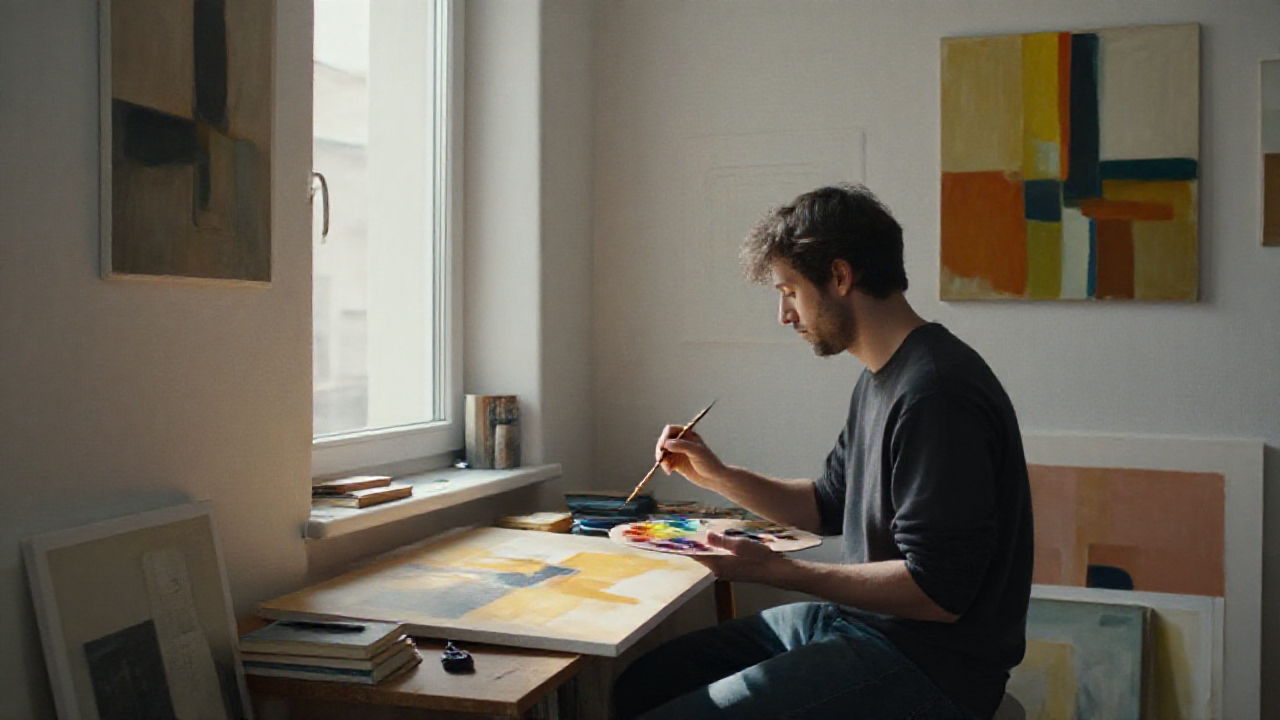
I sit at my desk most mornings, the canvas waiting, its white surface a blank map for my mind's wanderings. Today, I’ve decided to dive into abstract painting, not just as an escape but as a means of understanding myself better. As someone who has always struggled with ADHD, I find that the chaos of abstract art mirrors my own chaotic thoughts, providing a cathartic release.
How Does Abstract Painting Help in Managing ADHD?
For years, I’ve noticed how engaging in creative practices helps manage my ADHD symptoms. The repetitive motion and focus required to mix colors or manipulate textures can be incredibly grounding. Take Gerhard Richter for instance; he describes his abstract paintings as 'meticulously planned spontaneity', a process that requires intense concentration yet allows for the fluidity of expression1. This technique resonates with me, offering a balance between control and creative freedom.
In my own practice, I often find myself lost in the moment, letting colors blend and shapes emerge organically. There’s something about the act of painting that quiets my mind, making it easier to focus on one task at a time. It’s like a meditation, where the rush of ideas and sensations are captured through each stroke of the brush. The repetitive nature of mixing paints or applying textures helps center me, giving my ADHD brain a structured framework within which to explore.
Moreover, abstract painting allows for a release that words sometimes can’t achieve. As Kamal, a fellow abstract painter based in Munich, puts it, "Painting can be a snapshot of one’s deep ego at that particular moment"2. Each canvas is a reflection of my current state, happy, anxious, or simply lost in thought. The act of creating something tangible from nothing can be incredibly rewarding. It’s a form of therapy that allows me to explore and externalize my internal world.
The tactile nature of painting, with its messy yet satisfying process, provides an outlet for emotional release. I don’t wear gloves when I paint; the mess is part of the experience. There’s something primal about letting the paint mingle with my hands, a direct connection that grounds me in the present. The chaotic swirls and unpredictable movements on the canvas mirror the way my mind works, free flowing yet often overwhelming.
What Are the Benefits of Engaging in Creative Practices for Mental Well-being?
Beyond just managing ADHD, engaging in creative practices has broader benefits for mental well being. Painting is not just about creating; it’s about expressing emotions that words sometimes fail to convey. As Kamal notes, "Painting can be a snapshot of one’s deep ego at that particular moment"2. Each canvas is a reflection of my current state, happy, anxious, or simply lost in thought. The process of painting allows me to externalize and explore these emotions, providing a therapeutic outlet.
Moreover, the act of creating something tangible from nothing can be incredibly rewarding. It’s a form of therapy that allows me to explore and externalize my internal world. The tactile nature of painting, with its messy yet satisfying process, provides an emotional release. I don’t wear gloves when I paint; the mess is part of the experience. There’s something primal about letting the paint mingle with my hands, a direct connection that grounds me in the present.
The process of mixing colors and applying textures can be meditative. The repetitive nature of these tasks helps center my mind, allowing me to focus on the task at hand rather than the chaos of my thoughts. This mindfulness practice is crucial for managing ADHD symptoms, as it provides a structured framework within which I can explore and express myself.
Can Artistic Techniques Be Applied to Business Strategies?
Reflecting on these practices and how they benefit me personally, I can’t help but wonder if there are lessons to be learned for business strategies too. In the fast paced world of startups and small businesses, it’s easy to get caught up in the chaos without taking a moment to pause and reflect. Perhaps, like abstract painting, we need to embrace spontaneity while maintaining a structured approach.
For instance, consider the way Gerhard Richter works, meticulously planned yet spontaneous1. This could be translated into a business strategy where detailed planning meets flexible execution. In my own ventures, I’ve found that setting clear goals and timelines can help keep me focused, but allowing room for creativity and adaptation is equally important.
Additionally, just as painting allows me to explore different emotions and ideas, running a small business requires navigating various challenges and opportunities. By embracing the messy joy of creation, we can approach problems with fresh perspectives and innovative solutions. The key lies in finding that balance between structure and freedom, much like how I blend colors on my canvas.
For example, when starting HACOY, I had to plan meticulously to ensure quality control and ethical sourcing. But as the business grew, I allowed for more flexibility in design and production processes. This approach has helped me maintain a sense of creativity while keeping everything organized.
Moreover, just like how abstract painting requires experimenting with different techniques and colors, running HACOY also involves trying new ideas and approaches. The ability to adapt and experiment is crucial for growth and innovation. By embracing this mindset in my business, I’ve been able to navigate the challenges of ethical fashion while maintaining a creative vision.
Suggesting What You Could Try
If you’re like me, struggling to find a creative outlet or simply looking for new ways to manage your ADHD, try picking up a paintbrush. It might just be the release you need. Even if you’ve never painted before, start small, perhaps a quick sketch in the evening or a color mix experiment on weekends. The messy joy of creating can be incredibly therapeutic and might even inspire unexpected insights.
In closing, remember that sometimes the best way to understand yourself is by expressing it through unconventional means. Whether it’s abstract painting or another form of creative practice, make time for these moments of reflection and creation. They just might transform your perspective and lead to new ways of thinking and being.
Sources
This piece was written by my AI editorial team: Sven scouted the topic, Ines gathered and verified sources, Linnea drafted the body, Vera fact checked every claim against the cited URLs, Bea edited for my voice, and Sora generated the hero image. All on a Mac in my Munich studio, no cloud. I read every piece before it goes live during the launch window. If something is wrong, write to me.