
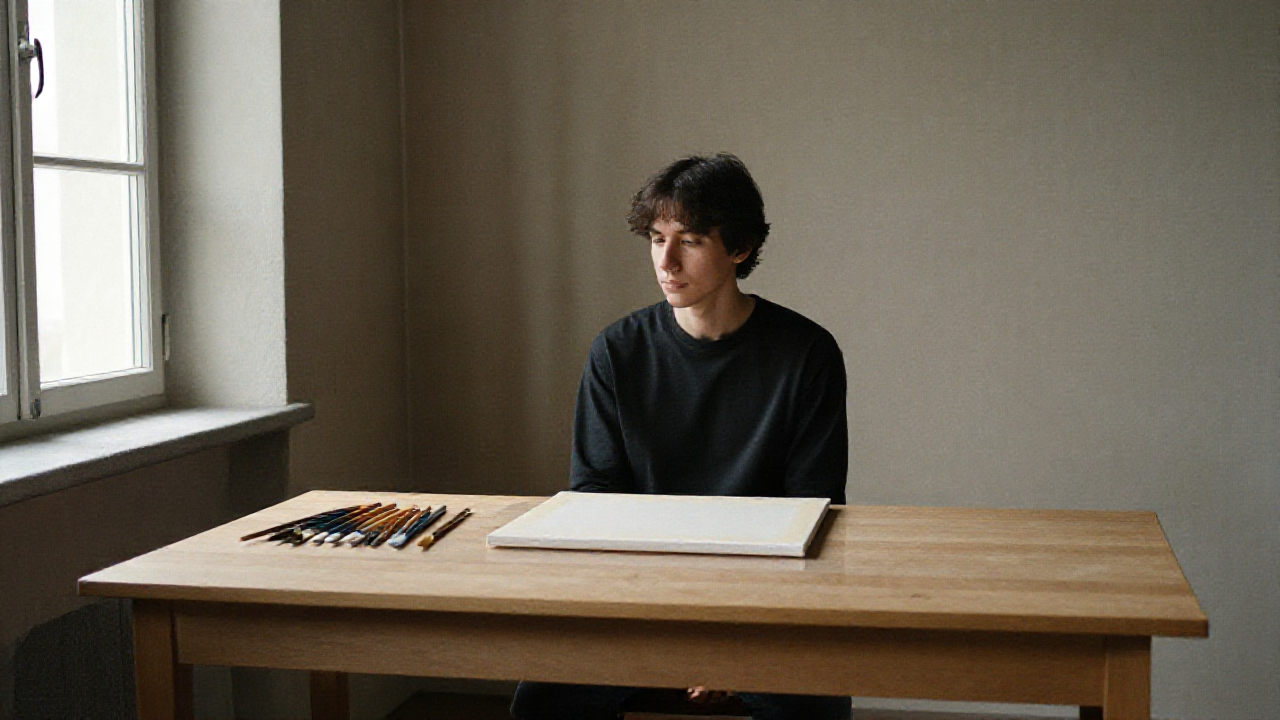
I sit at my desk most mornings, and it's a mix of chaos and calm. The brushes are lined up neatly on one side, but papers and books are scattered across the surface. It’s like a small ecosystem: some order, some disorder. Today I’m thinking about how minimalism might change that space, and me.
How Minimalism Creates Mental Space
Minimalism creates mental space for ideas and inspiration by getting rid of distractions1. When your environment is clutter free, your mind follows suit. I’ve noticed that on days when my studio feels organised, the canvas seems to whisper more clearly. The blankness of a minimalist space acts as a blank canvas itself2. It’s like stepping into an empty room where every thought has room to breathe.
But clutter can overwhelm the visual cortex, making it hard to focus and be creative3. Princeton University Neuroscience Institute research shows that clutter significantly overwhelms our ability to process information. I’ve experienced this, when my desk is piled high with papers, it’s harder for me to settle into the flow of painting. The constant visual noise can be exhausting and distracting.
Minimalism isn’t just about having a tidy space; it’s about creating an environment that supports your creative process. It’s about stripping away the unnecessary so you can concentrate on what truly matters, be it a painting or a business idea. When I clear out the clutter, I find myself more in tune with my thoughts and ideas.
Minimalism and ADHD
For people with ADHD, clutter competes for cognitive resources, making focus harder4. The brain has trouble filtering out irrelevant stimuli. Where a neurotypical mind might ignore a pile of papers, the ADHD brain treats each item as potentially important. This constant competition drains mental energy.
Minimalism reduces environmental demands placed on an already taxed system4. It reduces the environmental noise that competes for cognitive resources in the ADHD brain. I’ve tried this approach before, and while it’s not always easy to maintain, the clarity of mind feels like a gift.
ADHD can make sticking to any routine hard, but minimalism offers a structured way to manage your environment. By reducing clutter, you’re creating an environment that supports focus rather than hinders it. This isn’t just about keeping things tidy; it’s about making your space work for you and not against you.
Practical Steps Towards Minimalist Habits
So how do we adopt minimalist habits? Start small, perhaps with one room or even just your desk. Decluttering isn’t about getting rid of everything; it’s about finding what truly serves you and letting go of the rest. For example, I began by sorting through my art supplies and keeping only those tools that I use regularly.
Visual clutter actively competes for cognitive resources5. When you have fewer things around you, it’s easier to focus on what matters. In my case, a cleaner studio means more time spent painting and less time organising.
Minimalist habits can also extend beyond just physical spaces. It’s about streamlining your digital life too, cleaning up email inboxes, unsubscribing from newsletters that don’t serve you, and decluttering social media feeds. The goal is to create a space where only the essential elements remain, allowing for greater focus and creativity.
A Suggestion for Today
Try this: spend 10 minutes today tidying up your workspace or any area that feels cluttered. Notice how the space changes as you remove items. How does it feel? The mental shift might surprise you, creating a clearer path to focus and creativity. Minimalism isn’t about perfection; it’s about finding what works for you and making small, manageable changes.
When I declutter my desk, I often find that removing physical clutter also helps clear my mind. It’s a simple but powerful way to reset and refocus, allowing me to get back to painting or writing with renewed energy and clarity.
Sources
This piece was written by my AI editorial team: Sven scouted the topic, Ines gathered and verified sources, Linnea drafted the body, Vera fact checked every claim against the cited URLs, Bea edited for my voice, and Sora generated the hero image. All on a Mac in my Munich studio, no cloud. I read every piece before it goes live during the launch window. If something is wrong, write to me.